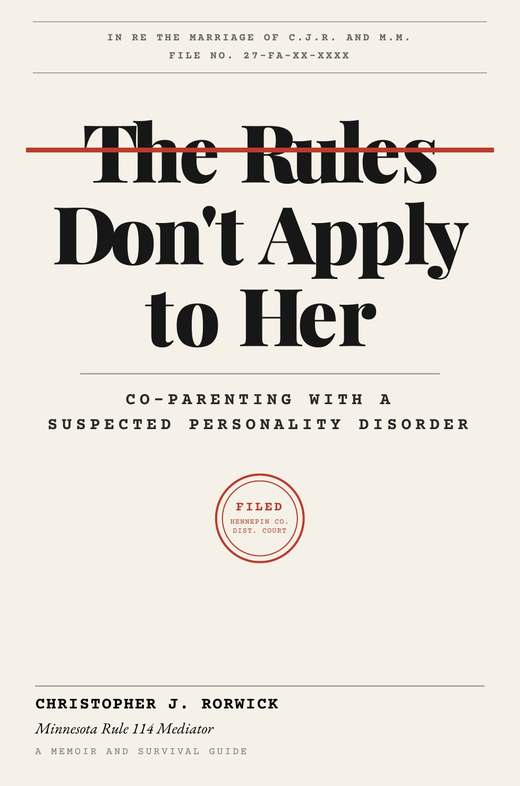
In re the marriage of C.J.R. and M.M.File no. 27-FA-XX-XXXX

The Rules Don't Apply to Her

Co-parenting with a suspected personality disorder

A memoir and survival guide from a Minnesota Rule 114 mediator who spent nearly two decades learning how to protect a child from a parent he came to believe had a personality disorder.

Written for the parent who is still in it.

Book cover: The Rules Don't Apply to Her, Co-parenting with a suspected personality disorder, by Christopher J. Rorwick

Start hereThree ways in, depending on where you stand.

Read the first pagesFrom Chapter 1. It takes about two minutes.

Chapter 1

The Nurses Didn’t Like Her (And I Should Have Asked Why)

There is a particular kind of intelligence that reads a room and finds the person with the most power, and then performs, flawlessly, for them. I watched her do this for years before I understood what I was watching.

She was a surgical technician and surgical assistant in Seattle when we met in 2005. In the operating room, she was extraordinary — fast, precise, unflappable under pressure. Surgeons lauded her. She had the gift of anticipating what they needed before they asked, of keeping her composure during the cases that went sideways, of projecting a calm that made everyone else in the room calmer too. If you asked a surgeon, they would have told you she was one of the best they’d worked with.

But the nurses, the people who worked alongside her day to day, who covered her shifts and shared break rooms and processed paperwork with her, told a different story. She lost positions over it. Not for her clinical skills, which were never in question. For something harder to articulate. Something about the way the rules didn’t apply to her.

Administrative protocols. Scheduling norms. The small bureaucratic architecture that makes a surgical unit function. These were, in her understanding, suggestions. Guidelines for people who lacked her judgment. She had a surgeon’s respect and that, apparently, was sufficient credential to exempt her from the parts of the job she found beneath her.

I rationalized every bit of it.

She’s too talented for the politics of this place. The nurses are jealous. She doesn’t suffer mediocrity, and that makes small people uncomfortable.

Here is what I know now that I didn’t know then: the nurses were a diagnostic instrument I didn’t know how to read.

The chapter continues in the book.

Why this one

"In high conflict with a partner who meets the criteria this book is about, the premise fails… You will pay for it anyway. Nothing load-bearing will come of it."

"The patience was the thing. The rope, uncoiled across time."

From Chapters 7 and 10

Inside the book

A prologue, fifteen chapters and an epilogue. It starts with the first warning signs, moves through the diagnosis question, family court, the parenting consultant and the limits of mediation, and builds to a letter to the author's son. Some of the chapters:

  • The Nurses Didn’t Like Her (And I Should Have Asked Why)
  • The Year of Accusations
  • The Sixth Birthday Party
  • When I Finally Had a Word for It
  • Big Scary Fight
  • The Parenting Consultant
  • The Parentified Child
  • The Rope
  • Seattle, and the Long Way Home
  • Seventy-Two Hours
  • The Pattern and the Men Who Lived It
Formats
Ebook and paperback
Length
About 140 pages
Size
6 x 9 inches
Author
Christopher J. Rorwick
Release
Coming soon

Free kit

The author

Christopher J. Rorwick is a Minnesota Rule 114 Qualified Neutral and the founder of Peaceful Path Mediation Services in Bloomington, Minnesota. He came to mediation the hard way: after most of his son's childhood spent in a high-conflict custody case, he trained to help other families find a less destructive path.

For more than twenty years he has also coordinated ground transportation for large corporate events.

peacefulpathmediationmn.com

For professionalsAttorneys, therapists, consultants, mediators.

Your clients are living the chapters in this book. It's a first-person account of what a high-conflict case looks like from the parent's side of the table, written by a Rule 114 neutral. One chapter argues for appointing a mental-health-trained parenting consultant in these cases, and explains why mediation stalls.

Bulk copies at cost and a short discussion guide for client handouts are available. Write to the press contact below.

Press and podcastsEverything a host needs in one place.

Short bio

Christopher J. Rorwick is a Minnesota Rule 114 Qualified Neutral and the founder of Peaceful Path Mediation Services. After nearly two decades co-parenting through a high-conflict custody case, he wrote The Rules Don't Apply to Her, a memoir and survival guide for parents who are still in it. He also coordinates ground transportation for Fortune 500 events.

Five conversation starters

  1. Why does mediation fail with a high-conflict partner, and what should you ask the court for instead?
  2. How do you document a custody case without feeding the conflict?
  3. The surgeons loved her and the nurses filed complaints: what early patterns look like.
  4. What a parentified child looks like, and how to reverse it.
  5. What a prepared child does when the worst message finally arrives.

Contact

hello@therulesdontapplytoher.com

Questions

Who is this book for?

Parents co-parenting with someone for whom conflict never really ends: the person who can't be reasoned with, who rewrites every agreement, and for whom the fight is the point. Ordinary advice fails here because it assumes both people want a resolution. If that sounds familiar, you are allowed to look closer. The book shows how to hold what you're seeing up against what clinicians have written about personality disorders, the way a careful observer would: describing behavior, not diagnosing, and using the pattern to decide what to do next. It is written for the parent still in it, while the child is still a child, and for the friend, relative or professional trying to understand.

What will I be able to do after reading it?

Answer a hostile message without taking the bait, keep a record a judge or consultant will take seriously, recognize the early patterns, and build a home steady enough that a child can stand down. The free kit gives you the first tools to start with this week.

Is it a memoir or a how-to?

Both. The story carries the lessons: nearly two decades of a custody case, told in order, with the practical takeaways drawn out as they were learned.

What does a mediator bring to this?

Years of sitting at the table with families, plus a hard lesson from the inside: mediation depends on both people wanting a resolution, and with a high-conflict partner it often stalls. The book explains what to ask the court for instead.

Can I read some before I buy?

Yes. The opening pages of Chapter 1 are on this page, and the free Weather Report Kit gives you the practical tools right away.

Are the people in it real?

The book is a true account. To protect privacy, names and identifying details have been changed. Only the author and his wife appear under their real names.

Where can I get it, and when?

Ebook and paperback on Amazon. Join the list above and you will hear the day it is available.